If you have a problem or need to report a bug please email : support@dsprobotics.com
There are 3 sections to this support area:
DOWNLOADS: access to product manuals, support files and drivers
HELP & INFORMATION: tutorials and example files for learning or finding pre-made modules for your projects
USER FORUMS: meet with other users and exchange ideas, you can also get help and assistance here
NEW REGISTRATIONS - please contact us if you wish to register on the forum
Users are reminded of the forum rules they sign up to which prohibits any activity that violates any laws including posting material covered by copyright
how to make FabFilter Pro-Q type high order lowpass?
how to make FabFilter Pro-Q type high order lowpass?
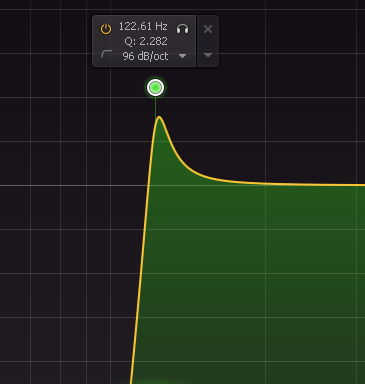
In FabFilter Pro-Q, low-pass (or high-pass ) filters could have Q-value even for those order >2. However, all common IIR design methods I know (such as Elliptic, Butterworth, Chebyshev I and II) don't have such property. So does anyone know some IIR design method that has similar property with the one in Pro-Q?
Re: how to make FabFilter Pro-Q type high order lowpass?
Put 8 standard 12 dB/Oct low pass filters after each other with the same frequency, and you will get the 96 dB/Oct filter
Re: how to make FabFilter Pro-Q type high order lowpass?
adamszabo wrote:Put 8 standard 12 dB/Oct low pass filters after each other with the same frequency, and you will get the 96 dB/Oct filter
Thanks! I've tried it, but when multiple filters being used together, it sharpens the peak that normally caused by high Q value. What should I do to keep the sharpness (or height) of the peak?
Re: how to make FabFilter Pro-Q type high order lowpass?
Multiply all the Q values with 0.1 or 0.2 or whatever number you want to make them smaller when they add up
Re: how to make FabFilter Pro-Q type high order lowpass?
Could this work for you (Quote from Robert Bristow-Johnson @ comp.dsp):
Use this in reference to the Audio EQ cookbook that presently (and
forever, i hope) lives at:
http://www.musicdsp.org/files/Audio-EQ-Cookbook.txt
for an Nth order Butterworth (N even or odd) you will have N/2 biquad
sections ((N-1)/2 for odd N or floor(N/2) for either even or odd N),
each will have the same resonant frequency w0 and will have Q:
Q = 1/( 2*sin((pi/N)*(n + 1/2)) )
where 0 <= n < (N-1)/2
then, use the cookbook LPF or HPF to get the coefs for each biquad
section.
if it's an odd order Butterworth, you'll need an additional 1st order
section:
H(z) = (b0 + b1*z^-1)/(a0 + a1*z^-1)
1st order LPF: H(s) = 1/(s+1)
b0 = sin(w0)
b1 = sin(w0)
a0 = cos(w0) + sin(w0) + 1
a1 = sin(w0) - cos(w0) - 1
1st order HPF: H(s) = s/(s+1)
b0 = cos(w0) + 1
b1 = -(cos(w0) + 1)
a0 = cos(w0) + sin(w0) + 1
a1 = sin(w0) - cos(w0) - 1
credits to Peter Schoffhauzer <scoofyGET_THE_SPAM_OUT@inf.elte.hu> for
catching and fixing errors.
r b-j